The Ie Family System in Japan Was Abolished During What Time Period
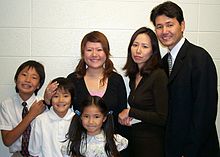
A Japanese family of all ages
The family unit is chosen kazoku ( 家族 ) in Japanese. Information technology's basically composed of a couple equally is the family in other societies. The Japanese family is based on the line of descent and adoption. Ancestors and offspring are linked together by an thought of family genealogy, or keizu, which does not mean relationships based on mere blood inheritance and succession, but rather a bail of relationship inherent in the maintenance and constancy of the family every bit an institution.
In any given period of history, all family unit members have been expected to contribute to the perpetuation of the family, which is held to exist the highest duty of the member.[i]
History [edit]
A groovy number of family forms take existed historically in Nippon, from the matrilocal customs of the Heian.
As official surveys conducted during the early on years of the Meiji dynasty demonstrated, the most common family unit class during the Edo (Tokugawa) period was characterized by patrilocal residence, stem structure, patrilineal descent and patrilineal primogeniture,[two] so a ready of laws were promulgated institutionalizing this family unit pattern, showtime with the "Outline of the New Criminal Law" in 1870.[3] In 1871, individuals were registered in an official family registry ( 戸籍 , koseki ).[4]
In the early twentieth century, each family was required to conform to the ie ( 家 , household) system, with a multigenerational household nether the legal authority of a household head. In establishing the ie organisation, the authorities moved the ideology of family in the opposite direction of trends resulting from urbanization and industrialization. The ie system took as its model for the family the Confucian-influenced blueprint of the upper classes of the Tokugawa period.
Authorization and responsibility for all members of the ie lay legally with the household head. Each generation supplied a male and female adult, with a preference for inheritance by the beginning son and for patrilocal union. When possible, daughters were expected to marry out, and younger sons were expected to establish their ain households.[ citation needed ]
Post-Earth War Ii [edit]
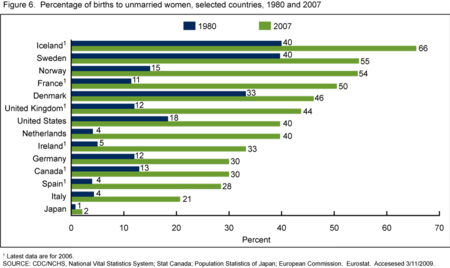
The percentage of births to unmarried women in selected countries, 1980 and 2007.[5] As can be seen in the figure, Nihon has not followed the trend of other Western countries of children built-in exterior of marriage to the aforementioned degree.
Later World State of war II, the Allied occupation forces established a new family unit ideology based on equal rights for women, equal inheritance by all children[ citation needed ], and free choice of spouse[ citation needed ] and career[ citation needed ]. From the belatedly 1960s, most marriages in Japan take been based on the common attraction of the couple and not the organization by the parents ( お見合い , omiai ) [ commendation needed ]. Moreover, arranged marriages might begin with an introduction past a relative or family friend, only bodily negotiations exercise not begin until all parties, including the bride and groom, are satisfied with the relationship.[ citation needed ]
Under the ie arrangement, but a minority of households included three generations at a fourth dimension considering nonsuccessor sons (those who were not heirs) often prepare upward their own household.[ citation needed ] From 1970 to 1983, the proportion of three-generation households roughshod from 19% to 15% of all households, while ii generation households consisting of a couple and their unmarried children increased just slightly, from 41% to 42% of all households. The greatest alter has been the increase in couple-simply households and in elderly single-person households.
Public opinion surveys in the late 1980s seemed to confirm the statistical movement abroad from the 3-generation ie family model. Half of the respondents did not think that the outset son had a special office to play in the family, and nigh two-thirds rejected the need for Mukoyōshi adoption of a son in order to continue the family. Other changes, such as an increase in filial violence and school refusal, suggest a breakup of strong family authority.
Official statistics signal that Japanese concepts of family connected to diverge from those in the Usa in the 1980s. The divorce charge per unit, although increasing slowly, remained at 1.3 per i,000 marriages in 1987, low by international standards. Stiff gender roles remained the cornerstone of family responsibilities. Most survey respondents said that family life should emphasize parent-child ties over married man-married woman relations. Nearly eighty% of respondents in a 1986 government survey believed that the bequeathed home and family grave should be advisedly kept and handed on to one'southward children. More than 60% thought it best for elderly parents to live with one of their children.
This sense of family every bit a unit of measurement that continues through time is stronger amid people who take a livelihood to laissez passer down, such as farmers, merchants, owners of modest companies, and physicians, than among urban bacon and wage earners. Anthropologist Jane Thou. Bachnik noted the connected accent on continuity in the rural families she studied. Uchi (here, the contemporary family unit) were considered the living members of an ie, which had no formal beingness. Yet, in each generation, there occurred a sorting of members into permanent and temporary members, defining different levels of uchi.
Various family life-styles exist side by side in contemporary Nihon. In many urban salaryman families, the husband may commute to work and return late, having petty fourth dimension with his children except for Sundays, a favorite twenty-four hour period for family unit outings. The married woman might be a "professional person housewife", with nearly total responsibility for raising children, ensuring their careers and marriages, running the household, and managing the family budget. She as well has primary responsibility for maintaining social relations with the wider circles of relatives, neighbors, and acquaintances and for managing the family unit's reputation. Her social life remains separate from that of her husband. It is increasingly probable that in addition to these family responsibilities, she may also take a function-time job or participate in adult education or other community activities. The closest emotional ties within such families are between the female parent and children.
In other families, particularly amid the self-employed, hubby and married woman piece of work side past side in a family unit business organization. Although gender-based roles are clear cut, they might not be as rigidly distinct equally in a household where work and family unit are more than separated. In such families, fathers are more involved in their children's development because they have more opportunity for interacting with them.
As women worked exterior of the home with increasing frequency showtime in the 1970s, there was pressure on their husbands to take on more responsibleness for housework and child care. Farm families, who depend on nonfarm employment for most of their income, are also developing patterns of interaction unlike from those of previous generations.
The monogamous and patriarchal family has prevailed since the 8th century. If a married woman had no children, the husband often maintained a concubine, whose offspring succeeded the family's headquarters, thus ensuring its continuation. When neither the married woman nor the concubine gave him a son, the custom immune the head of the family to adopt a successor. [half dozen]
Household members can be classified into two categories:
- socially recognized equally related in the family line, chokkei, which includes successors, their spouses and possible successors,
- socially recognized members equally external family unit members, bokei, nether which all other members of the family are grouped family, including relatives and servants. [7]
Succession [edit]
In the traditional Japanese family, one male offspring who is to succeed to the headship of the family unit lives with his parents after his marriage. He assumes the headship and has to accept care of the parents when they accept become aged. In addition, he is responsible for the back up of bokei member and directs the labor of family members in the direction of the household. Couples in successive generations live together nether the aforementioned roof.[vi]
Succession in the Japanese family does not simply hateful inheritance of the deceased's holding; and the inheritance of property itself has a distinctive meaning, which reflects the institutional demands of the family unit. Succession in Japan means katokusozoku, or succession to family unit headship.
Katokusozoku aims to attain directly the continuation of the family every bit an institution. The patriarch, responsible for family continuation, has to decide in advance who is the man to succeed him in the result of his expiry. He usually selects a certain son as the candidate for his successor. When he has no offspring at all, the patriarch oft adopts both a boy as his successor and a girl equally the successor'due south wife. In mukoyōshi adoption, information technology does not matter whether or non the boy and the girl concerned have blood relationship with the patriarch or with his wife.[7]
The traditional ideal of the ie system designates the oldest son every bit an heir to the family, and expects his family to live with his parents. When the oldest son is not bachelor or not able to assume this position, one of the younger sons may exercise and so. The elderly parents may opt for living with one of their married daughters, usually when they have no available son. Implied hither is a sex/age hierarchy in terms of living with the parents, descending from oldest son to youngest son, and oldest to youngest daughter. It thus tin can be expected that oldest sons and oldest daughters without brothers are more probable to live with their parents than other children.[8]
See also [edit]
- Family unit law in Nippon
- Bunke
- Honke
- Yagō
- Ie (Japanese family system)
- Family policy in Nihon
- American family structure
References [edit]
- ^ (Ariga 1954)
- ^ Wall, Richard; Hareven, Tamara K.; Ehmer, Joseph (eds.). Family History Revisited: Comparative Perspectives. pp. 343–344.
- ^ Röhl, W. (ed.). History of Constabulary in Japan Since 1868. pp. 307–321.
- ^ (Mosk 1980)
- ^ "Irresolute Patterns of Nonmarital Childbearing in the United States". CDC/National Centre for Wellness Statistics. May 13, 2009. Retrieved September 24, 2011.
- ^ (Ariga 1954)
- ^ (Ariga 1954)
- ^ (Kamo 1990).
-
 This article incorporates public domain material from the Library of Congress State Studies document: "Nippon".
Bibliography [edit]
- Ariga, Chiliad. (1954). "The Family in Japan". Marriage and Family Living. 16 (4): 362–368. doi:10.2307/348444.
- Johnson, E. (1964). "The Stalk Family and Its Extension in Nowadays Day Japan". American Anthropologist. New Series. 66 (4, Office 1): 839–851. doi:10.1525/aa.1964.66.4.02a00070.
- Kamo, Y. (1990). "Husbands and Wives Living in Nuclear and Stem Family Households in Japan". Sociological Perspectives. 33 (iii): 397–417. doi:10.2307/1389067.
- Kitaoji, H. (1971). "The Structure of the Japanese Family". American Anthropologist. 73 (5): 1036–1057. doi:x.1525/aa.1971.73.5.02a00050.
- Koyano, South. (1964). "Changing Family unit Beliefs in Four Japanese Communities". Journal of Spousal relationship and the Family. 26 (2): 149–159. doi:10.2307/349721. JSTOR 349721.
- Mosk, Carl (1980). "Nuptiality in Meiji Nippon". Journal of Social History. 13 (three): 474–489. doi:x.1353/jsh/thirteen.three.474.
- Spencer, R. F.; Imamura, 1000. (1950). "Notes on the Japanese Kinship Organization". Journal of the American Oriental Society. lxx (3): 165–173. doi:10.2307/596262. JSTOR 596262.
- Takakusu, J. (1906). "The Social and Ethical Value of the Family System in Japan". International Periodical of Ethics. 17 (1): 100–106. doi:ten.1086/206267. JSTOR 2376103.
- Wilkinson, T. O. (1962). "Family Construction and Industrialization in Nippon". American Sociological Review. 27 (5): 678–682. doi:10.2307/2089625. JSTOR 2089625.
Source: https://en.wikipedia.org/wiki/Japanese_family
0 Response to "The Ie Family System in Japan Was Abolished During What Time Period"
Post a Comment