Bibliogroupthe Corsair a Gazette of Literature Art Dramatic Criticism Fashion and Novelty
RISEBA, Riga
Apr, 2016 I'grand currently having a wonderful time as a guest of RISEBA, the university where business meets the arts, in Riga, Latvia. I gave a invitee lecture there on Tuesday (details here), …
Source: RISEBA, Riga
Reflection
-

- Spirit Photography (2014) H. Newall
'history never grows too one-time or out of date.'
Jill Enfield, Online
I began this web log with a single image of a lit chandelier hanging in a blue forest. There was no commentary considering information technology was an accidental post while I learned near blogs, simply so I left the paradigm there… This is happenstance. I chose the image at random.
This blog has turned out to exist most history: even from the starting time, I was enlightened of Phylogeny recipitulating Ontogeny because, to look at myself every bit a practising artist, I felt I had to go back to all beginnings, not just of my first encounters with photography, but back to the beginnings of the matter itself, and Fox Talbot and his shadowgrams. This historiographical arroyo helped me to untangle in my own mind what I felt, what I knew, and what I wanted.
I've always been interested in the paraphernalia of old science. I accept an old brass microscope and several old bellows cameras. None of them work, just they stand for a fourth dimension when things weren't virtual, when they were solid and real and well-made. Reading about the old physical processes began to parallel my extant desire to go my hands muddy and scratch marks into real surfaces. I've not done that yet – I've been as well busy making an exhibition and performance projection forThe Snow Queen, merely I've had a chance to meddle with things in my digital sketchbooks, and experiment with the Christmas Light Drawings and the Victorian Silver People. Equally a result, I now know I want to explore the possibilities of camera gratis photography and try out dominicus prints and the processes used past Martha Madigan, Floris Neusüss, Pierre Cordier, Garry Fabian Miller… so many people and then little time…
I've found I want to explore, or possibly fifty-fifty exploit the past, while avoiding whimsical vintage, floaty reconstructions, because my work isn'tnear the by. The past is a foreign canton, and while they're busying doing things differently there, I'm mining it of its resources. This is unashamed chrono-colonialism: the past offers me things I can use; knowledge of chemical processes, processes which are thoroughly gimmicky in the hands of artists like Madigan and Neusüss; information technology offers me vocabularies and found image content in the grade of forgotten photographs. I don't want to illustrate the past. I want the past to illustrate the present and the time to come. This is a course of postmodern bricolage. Perhaps that's why I like composites and collages, because they are the concept made tangible.
I am a postmodernist (with cultural materialist tendencies): the work of Annu Palakunnaku Matthew is thus also very highly-seasoned, peculiarly since her methods recapitulate my ongoing want to explore fakes and hoaxes… cf.The Xanthous Wallpaper(2010) in which I made performance photography for a product which never happened, andDying Swans and Dragged Upward Dames(2013; 2014), the exhibition of reconstructed dance photography. Part of this blogging process has involved engaging with old friends such as Roland Barthes, Susan Sontag, Philip Auslander, merely from new angles. Before, these writers were lenses through which I examined fiction, or other people's photography and performance documentation. Now, they are the voices of the anxiety of influence (to borrow Harold Blossom's phrase) as I myself make piece of work…
And I've realised throughout this process what I feel about photography equally fine art. And why street photography is art; and why vacation snaps aren't. And I've as well learnt a lot from reading nearly the pursuit of technical excellence that sometimes perfection is less than art. Art lies in the soapbox between imperfection and aspiration; fine art can be found in the novel uses we put things to, not in perfectly formed and perfectly framed artifacts. Art is risk, non a safe bet.
Finally, it has been reinforced that there is dazzler in chance and happenstance. In that location are latent histories and unspoken narratives, both cultural and critical, to exist explored in broken things: there are, equally yet, lots of unwritten fairy tales.
And so I finish with Goodrich'due south quotation on Moriyama, whose work I looked at when it rained and rained.
Daido Moriyama is a master of imperfection, his skill with 'misuse' of a camera is unsurpassed. His images sometimes lack focus, may exist overexposed, also grainy or blurred. Simply it is for these reasons that he remains a legend amongst photographers.
(Goodrich, 2008: online)
Bibliography
Goodrich, A., 'Learn From the Masters: Daido Moriyama, the Master of Imperfection'Japanorama, 1 November 2008, http://world wide web.japanorama.co.uk, Online
Writing With Light

I Heard what Yous Were Thinking (c.2008) H. Newall
When I'm not holding a camera up to a automobile windscreen, I'm opening its shutter on a bulb setting onto lights in the night from a continuing position. It only takes a few in and out breaths to write lite onto the sensor, and so now I write things in the air with the lens, and and so when I want to move to something else I cover the lens momentarily and prepare up again.

Dearest Letter II (c.2008) H. Hewall
And whilst it's all about chance and not knowing what will come up out, the more than I do this, the more than I can command the effect because I can sort of predict what might happen and conform accordingly.
The prototype at the peak of this mail service, Alastair on the Hill, is not a Photoshop blend: the metropolis lights were drawn onto the sensor, then a strobe was deployed onto the figure while the shutter was notwithstanding open up. The other images to a higher place are, however, straight out of camera. At the time I took them and first looked at them, I was blown away. I'd plant a new affair to do with the camera. Now they look unfinished: at present that the initial joyful ludic impulse has been satisfied, images like this are raw material photographs to alloy in Photoshop layers.
The images beneath are some of the ones I've been experimenting with over Christmas, the season of darkness and fairy lights. This has to be done in darkness bar the lights that will exist the 'pencils', to steal Fox Talbot'due south metaphor, because any stray lite volition smudge and begin to impress the room features onto the sensor. I wait till everyone's gone to bed. Then, information technology'south easy to spend time into the small hours filling a camera card with photograph later on photograph of lights fatigued over the sensor past the action of moving the photographic camera around when the shutter is open. It mystifies the cat.

Burn (2014) H. Newall
Fire, above, and the images below are layered and blended and so that I take some artistic control over a final outcome. I play with different lenses and different focal lengths. I shift focal lengths on the zoom lenses during the shot. I spin. I wave the camera. I write my name in the air…

Lights (2014) H. Newall
All of these images were made in Photoshop using the same photographs merely in dissimilar combinations. In this sense, the aleatory aspect of the work continues in Photoshop, since I cannot anticipate the issue, I tin only experiment and encounter how things turn out. I honey this phase because it has a zen sense of now. In that location is no earlier or later on. Bayles and Orland write that, 'Art is similar outset a sentence before you lot know its ending' (1993: 20). Here, the work isn't finished, to paraphrase Leonardo da Vinci, it isabandoned.

Chandelier (2014) H. Newall
Chandelier is at least two photographs blended together. The terminal epitome is then tightly cropped in to brand a composition out of the flow of the light streaks. It's hard to compose in photographic camera because it's difficult to judge where the light streaks will end up on the sensor.

Flash (2014) H. Newall
Flash is a blend of a close upward and a long shot. Information technology's almost the same blended prototype every bitPale, only with different blending modes practical.

Pale (2014) H. Newall
I like symmetry, although I acknowledge there can exist nothing more pleasing than a pattern disrupted. Blueish Orchid was fabricated by repeating layers over themselves andblending them through so that the architecture created by the lite is repeated. Colours were adjusted in a Hue and Saturation Aligning Layer and in Curves. I similar glowing colours against darkness: information technology's what it looks like inside a head total of synaesthesia.
These images feel finished, just my plan is that they are the raw material for a further procedure of integration with the silverish people of the one-time photographs. They may end upwards as animations, or as stills, maybe both…

Blue Orchid (2014) H. Newall
Shooting Out of Windows

Traffic H. Newall
I like shooting out of windows. Shooting pictures, I hasten to add. It started on the drive domicile from the airport after the fateful Lanzarote lite writing trip. They have to be moving windows. Car windows. I am in the rider seat (earlier y'all abort me).I've even so to try a train window. This is light writing on the wild side. No control. No idea fifty-fifty of what will come up out. Totally aleatory process. Approximate the exposure using a bulb setting. Point the camera out of the windscreen. Point and approximate.

Industrial Scene I H. Newall
The lit-up street furniture is stock-still, lampposts, illuminated sins, traffic signals, Shop fronts, all tin can be factored into a light drawing 'laissez passer', just the movement and speed of the car are adventure elements, as are the headlamps and tail lights and indicators of others cars… Time of day is a cistron. More ambient calorie-free means the lite exposure can exist less, and the canvas will be smudged electric blue or pink (or whatever the heaven and weather is doing) in tone. It'southward all beautiful guess work. And there's no looking till afterwards, because after every shot the camera has to relieve it to the disc, and then it's time to shoot once more. My husband is at present an experienced light pass commuter.

Industrial Scene II H. Newall
The planning is in what settings to use for a particular pass: the Runcorn Widnes Bridge, for case, is brilliantly lit. Too brilliant maybe, merely it'southward on my list to shoot: its architecture is spectacular at dark when, on calm nights, it is reflected perfectly in the River Mersey, so that information technology becomes one office of a pale oval of steel against the night heaven. This is one grade of night photography where skill and feel assists the photographer to take the shot. Skill and experience and the sense of an predictable effect affect the technical choices fabricated. In shooting from a moving car, nevertheless, the shot is never anticipated.

Industrial Scene Iii H. Newall
The issue, however, is sort of predictable after a while: I know I will grab parallel lines of bright lite in glowing reds and ambers and white. I know these lines volition fasten across the canvas, in parallels of jittery ups and downs, each jitter recording a jolt of the car over uneven bits of route. I know the sheet will be an boilerplate of the time the shutter was open. And sometimes it'southward a good result and sometimes less so. But the result is always a surprise.

Street Lamps H. Newall
Maybe this is the parallel of a Jackson Pollock spatter of paint. He chose his colours but the verbal trajectories and patterns of the paint spatters were, in the finish, divers by the chaos of chance.
A Manifesto

Silver H. Newall
- I shoot totally in manual;
- I mess with the controls;
- I get messed up past control;
- I shoot as many photos as I want, considering it's digital and I can;
- I endeavor to get it right in camera, merely I love what post-product can exercise (alter the colour of a wearing apparel; shift the light balance; shift the low-cal; change the properties; alter the tilt of a mitt…);
- I shoot in RAW;
- Photographs are raw material;
- Who cares about SOOC?;
- I composite; collage; remake;
- I take my photographs in a camera: I make my images in Photoshop;
![Walk on the [Wild Side]](https://blacktulipimages.files.wordpress.com/2014/01/4771230642_f62237eefa_b.jpg?w=640&h=452 "The Wild Side")
Walk on the Wild Side H. Newall
- The photograph can be an object: limited edition images on paper, forest, clay, glass; or stitched and pierced photographs; perhaps all of these all at the aforementioned time;
- The photograph can be an ephemeral affair: an image on unfixed light sensitive paper in a dark box… How many times tin you lot look at it before information technology's gone?
- The projected epitome as art; where does the fine art reside? In the sparse spindles of light rays falling on a wall, or a body, or a tree, or a wall of water? Or maybe it lies in the digital file in the reckoner? Or in the idea?

Nonetheless from performance projection for The Ghost of Someone Non Nonetheless Drowned (2011) The Victoria Baths, Manchester
- I rarely take any of my (heavy) DSLRs out to take holiday 'snaps': I utilise my iPhone to take snaps;
- I employ some of these snaps every bit textures in my composites;

- I hate the discussion snaps;
- Snappy snaps;
- I don't want to take your wedding photos or your issue photos; especially non for free;
- I tin lie on the footing and have close-ups of gravel for hours;
- There is e'er something to photograph.

Still Life: H. Newall
But is it art?

The World'south well-nigh expensive photograph to appointment. Rhein Ii (1999) Andreas Gursky.
Sold in 2011 for $4.3million.
In all the writing and thinking near History and my own histories, the debate 'Is Information technology Art?' keeps coming back.The debate seems to coalesce nearly two areas:
- The fourth dimension taken to brand an image
- Mechanical processes involved
It's a debate I've had with myself well-nigh my ain processes: making pictures with a camera does seem easy in comparing with making paintings or drawings, and yet the hours it tin take to perfect one photographic image seems to negate this erstwhile statement. It'southward easy to press the shutter button, but information technology's hard to photograph things well; information technology's difficult to process images, either in a chemical or a digital darkroom.
In that location is also a subtext which might be termed the democratisation of making art: who is allowed to be an artist has been – and still is to an extent – controlled in order by a social system whereby artists must either have contained means or patrons or spouses with a regular income. The photographer equally businessperson, and thus involved in dirty mercantile activity, is not a existent artist: artists have a college calling. Fine art is, after all, not made for coin, but for love. But we all have to eat. We can't all lie around, writing poetry, and dying of consumption in attics…
From photography's inception, the terminology of the artist is nowadays in discussions of the daguerreotype, the talbotype, and yet the story is also of a relentless drive into mass production (and thus commercialism), and information technology is this and the mechanical aspects of the process which eclipse whatsoever notion of artistry in the taking and production of an paradigm. Commentators, non least of all Flim-flam Talbot, write of Nature existence the author of the works, and of images making themselves. Play tricks Talbot wrote:
it is non the creative person who makes the pic, but the film which makesitself. All that the creative person does is to dispose the apparatus before the object whose prototype he requires; he then leaves it for a sure fourth dimension, greater or less, according to circumstances. At the finish of the fourth dimension he returns, takes out his picture show, and finds it finished.
(Talbot, 1839: online)
So whilst he speaks of the artist, he claims that this artist does nothing other than deploy the camera, and rather disingenuously neglects the artistry of choosing what the lens should frame; the craftsmanship of preparing the plates beforehand; the skill of knowing how long to make the exposure for; not to mention the skill in later on developing and fixing the epitome.
Lady Elizabeth Eastlake writing in 1857 is as adamant that photography cannot be art because, in a long winded flowery fashion, she says that art selects and refines, while the photographic camera does not: it takes everything indiscriminately (in Trachtenerg, 1980: pp58). This is the same issue noted by Ian Jeffrey in Photography: A Concise History: 'Lured past hallowed reputations, photographers stationed their instruments in front of abbeys, castles, palaces, dazzler spots – and came away with untidy evidence of building projects, repair work, scaffolding, stonemasons' yards, street trade and tumbledown housing'. (1981: 14). Photography is not a replacement for painting or drawing, equally Flim-flam Talbot with his complicated camera lucida initially hoped, 'belongings, as he believed,' as Lady Eastlake writes, 'the keys of imitation in his hands'; it is, however, a different art all together.
Walter Benjamin's account of art and photography's early skirmishes is enlightening:
With the advent of the showtime truly revolutionary means of reproduction, photography, simultaneously with the rise of socialism, fine art sensed the approaching crunch which has become evident a century subsequently. At the fourth dimension, fine art reacted with the doctrine ofl'art pour l'fine art, that is, with a theology of art. This gave ascent to what might be called a negative theology in the grade of the idea of 'pure' art, which not only denied any social function of fine art only also any categorizing by subject thing.
(1968: 224)
And then 'Fine art' was threatened. Maybe the same process is at work with all the current talk of the demise of the fine art of photography due to the rise and rise of the smartphone camera: Stuart Jeffries writing in The Guardian cites photographer Antonio Olmos as maxim, 'There have never been so many photographs taken, but photography is dying.' And then Jeffries asks: 'Isn't what nosotros're witnessing a revolution in photography, thanks to digital technology, that makes information technology more than democratic?' And Olmos is businesslike and agrees, but thinks photography is dying for a much more prosaic reason: 'The iPhone has a crap lens. You can take a beautiful picture on the iPhone and accident it up for a print and it looks terrible.'
But who needs prints in a paper-free globe? [Jeffries asks.] "For me the print is the ultimate expression of photography," [Olmos] retorts. "When I practice street photography courses, I get people to impress pictures – frequently for the showtime time. The thought is to tedious them down, to make them make – not just have – photographs."
(Jeffries, 2013: online)
The slowing down is the thing. Artists, then, are slow… Ironic that Lady Elizabeth Eastlake should note in 1857 that the early scientist-photographers were seeking the 'element of rapidity' (1857: 52). Now that we accept information technology, nosotros need to slow it all down again. Unless we're street photographers…
…In Osaka in 2011, I saw an exhibition of piece of work past street photographer Daido Moriyama. It rained torrentially while I was at that place. Later I'd looked at the hundreds of images on brandish, I sat for hours in the cafe leafing through the exhibitionbook I'd bought. And because information technology was still raining – the kind of rain that soaks you lot through merely thinking about it – I went circular the exhibition over again. Information technology was stunning fifty-fifty the 2d time around. And this fourth dimension I watched the film of Moriyama talking about his procedure demonstrating how he selected and shot this subjects . He talked in Japanese, but the motion picture camera walked with him equally he strode through a city, Tokyo peradventure, camera in hand, cigarette betwixt his fingers, and shot things, without breaking his pace… Information technology probably took longer for me to look at the images than it did him when he was walking and shooting. And yet each prototype, black and white and hung against white, framed as art, was grimy, sometimes blurred, sometimes off kilter, and always starkly beautiful… would I think that if I came across such images on the internet, not labelled equally 'art'?… we swiftly motion-picture show swiftly through images, taking them in at a glance: we Flickr them, we click and flick and click through them. Sontag makes the observation that the photo in print does not command us like the photograph on flick does, as compared to a book (or a computer screen)
The sequence in which the photographs are to exist looked at is proposed by the order of pages, but zippo holds readers to the recommended order or indicates the corporeality of fourth dimension to be spent on each photograph.
(1979: 5)
True enough, we can walk as fast or as slow as we like in the gallery, and in a book, we can plough the pages equally we please. But in a film… and maybe it was watching the movie of Moriyama'southward photos that really burned them into the retina of my heart. Film however, every bit Sontag notes, chooses how long you spend with each image. So perhaps then, if artists aren't slow, art is slow. And maybe, every bit Sontag suggests, movie is the best medium for exhibiting photography.
Judge for yourself: for copyright reasons, I straight you to Moriyama's site rather than post them here, but I can share images I took in Nippon in response. These are almost SOOC, in that in post, I converted them to black and white and sharpened them because I shoot in RAW. For the rest, each image is equally I took it.

Cycle (2011) H. Newall
I would never dream, commonly, of shooting in the street like this, but Moriyama's show encouraged me. EnCouraged. I was brave, suddenly. And being in a foreign world somehow helped.

Hiroshima (2011) H. Newall
Perhaps information technology was because, every bit a foreigner it was easier to 'see' the street environment. It was a foreign identify to me: it was the urban center defamiliarized. And there certainly was the sense that equally a greenhorn I had 'permission' to take pictures that I would commonly find it excruciating to accept. I tin't have street images in the city near where I live because someone might terminate me; someone might object; someone might listen… Certainly all these things were true in Osaka, merely they didn't seem to matter and so much. I took the nighttime images walking circular by myself with a huge grabbable camera. Wouldn't dream of doing that in the United kingdom of great britain and northern ireland.

Subway (2011) H. Newall
Snaps. Snappy to take. Snapped fast. Non e'er fine art. Art is in the eye of the artist. Art is in the eye of the beholder. Art is beautiful. Art is imperfect. Fine art is dangerous. Art is a lie to tell us the truth. Arts snaps at our complacencies. Snaps.
I detest snapping. I used to take hundreds of photos on holidays, always with the hope that something might happen and they'd metamorphose between the shutter release and the prints arriving back into something wonderful. And sometimes they were quite good, just by and large they were disappointing, and mainly considering I'd had no control over much of the shooting and processing. This was considering I always had crap point-and-shoot film cameras and then couldn't actually exercise much other than command what I pointed the camera at. The rest was car shutter, auto aperture, auto ISO: the camera was deciding everything, and and so Kodak or Max Speilmann got to make up one's mind the rest. And this is why my pictures weren't art, fifty-fifty if some of them looked quite good some of the fourth dimension.
Art then is control over the upshot? Bayles and Orland write, 'Command, apparently, is not the answer. People who demand certainty in their lives are less likely to brand art that is risky, subversive, complicated, iffy, suggestive or spontaneous' (1993: 21). So, control sometimes. Sometimes, it's experimentation which requires a loss of control, but here, the camera would either try to recoup, or I'd go stickers over the photos from the Photo Lab, which said polite things but the messages implied: 'This rubbish movie would greatly be improved if you'd stopped experimenting and taken it the way the camera manufacturers thought you should…'
Then I got a big SLR and went to Africa, and things improved a little. Just I withal had no control because I was non developing my images. And whilst I considered setting up a blackness and white nighttime room, I didn't take the space, nor at that fourth dimension the funds…
So I came habitation from Africa with a suitcase full of Max Speilmann lions and got a digital point-and-shoot. It promised to be different. Information technology promised to be cheaper. I pushed it to its limits. It was still not what I was looking for, although it was certainly cheaper at present that I was no longer stockpiling all those packets of unlooked at prints… And then I got a DSLR, a Canon 50D. And the Apple programme Discontinuity. And shortly afterwards that, Photoshop. And and so a 5D Mk II… And all of a sudden, hither was control in camera. And here was control postal service-production. And hither were two new debates to contend with:
- Digital photography is not as good as film photography: discuss
- Postal service-product is not equally good as getting information technology right in photographic camera: discuss
These are large arguments I can't rehearse here – I can, all the same, tell you my answers: yes, digital is freedom; yes, mail-product is my favourite part – but out of it all – the snapping and the printing and the digital artillery race upsizing – comes a manifesto for making images. It was in that location all along, this manifesto, it just took me a while to see it.
Bibliography
Bayles, D., & T. Orland. (1993) Fine art and Fear: Observations on the Perils (and Rewards) of Artmaking, Santa Cruz: The Prototype Continuum
Benjamin, W., 'The Work of Art in the Historic period of Mechanical Reproduction' in Walter, B., H. Zohn (trans.) (1968)Illuminations: Essays and Reflections, New York: Schocken Books
Fox Talbot, W. W., 'The Pencil of Nature: A New Discovery' inThe Corsair. A Gazette of Literature, Art, Dramatic Criticism, manner and Novelty (New-York) Vol. 1, No. five (Saturday, xiii April 1839) pp. 70-72. Online resource, The Daguerreian Society)
Jeffries, Due south., (2013) 'The Death of Photography: Are Camera Phones Destroying an Artform?'The Guardian, thirteen December 2013, (Online)
Sontag, S., (1979) On Photography, London: Penguin
Photo Collage
In a previous post, I wrote near the postmodern bricolage of reworking history, and playing, in both course and content, with erstwhile photographs, but photograph-collage tin can and does brand use of the nowadays, and this excites me also: consider artists such as Serge Mendzhiyskogo, who takes hundreds of photographs of familiar views and cuts them into multiple strips and combines them. This is a strong example of the trope that Russian Formalist, Oscar Shklovsky termed остранение (ostranenie) ordefamiliarisation, where what we know is represented to the states from a new angle so that nosotros can run into it anew. This is a device in literary works of art, merely I notice its use applicable to photographic artists such every bit Mendzhiyskogo. Shklovsky began his famous essay 'Art as Device' inTheory of Prose (1925), with the phrase: 'Art is thinking in images'. And the essay ends discussing rhythm, and the disrupted rhythms of prose and poetry. Hither in Mendzhiyskogo's images we encounter disrupted rhythms, which are, nevertheless, because they create patterns, visually satisfying. These disruptions and patterns are a form of thinking about the subject because they defamiliarise, they make u.s., the viewer, reconstruct the epitome, whilst we simultaneously enjoy the patterned deconstruction we have been given. If this image were a text (and nosotros are reading it, so why not?), then there is a pleasure in the text, to take Barthes's phrase.

Serge Mendzhiyskogo Collage

Serge Mendzhiyskogo Collage
Not all Mendzhiyskogo's piece of work is monochromatic: his colour collages are every bit stunning, only I prefer the stark patterns that emerge in the monochromatic pieces. Work like this cannot exist mentioned without reference to Hockney. His collage work is sometimes built in chaotic, sprays of images, foregrounding with the white frames of the polaroids, the 'blended-ness' in the picture. Mother Bradford Yorkshire fourth May 1982 and Sun On The Pool Los Angeles April 13th 1982 are examples of this. Some however, such equally Paint Trolley, L.A . (1985) or Pearblossom Highway (1986) , seem initially to be 1 prototype, just here the differing shades of colour in the photographs that make up the whole mottle the full paradigm, slowly breaking the totality of the prototype autonomously. In the Polaroid Composites and Photographic Composites, he exploits the camera'southward centre and how it reads the light, shifting the colour to expose correctly. They are fascinating images to look at: it'southward equally if he'southward captured each micro epitome the centre sees which make upward in the encephalon the total paradigm of the scene nosotros come across.
The other contemporary artist using photo collage whose work I admire profoundly is David Mach. I start encountered his work when I was asked to write a Christmas play by the 2011 King James Bible Trust to exist staged in Hampton Court Palace. Mach was deputed past the Trust to brandPrecious Low-cal, a series of sculptures and collages, which included the head of the devil synthetic out of match heads and epic, colourful scenes from the Male monarch James Bible ripped into the present day with bright colour and roiling movement, so that they seem similar stills from a movie. His collages are frequently crowded with people, and of near apocalyptic sensibilities… Something in them always seems about to explode: in one image it already has, for in The Plague of Frogs, a auto bomb goes off outside Belfast Urban center Hall. They are immense. They are historical subjects given a massive gimmicky twist and they are superb.

The Plague of Frogs (2011) David Mach

Jesus Walking on Water (2011) David Mach
A few years ago, I discovered how to apply the Photoshop pen tool effectively, and I've been making digital collages and composites, and shooting pictures of buildings and things ever since. Things. Things are park benches, phone boxes, flowers, clocks, lamp posts, people, birds, clouds, skies, streets, things. I never know what kind of things I might need… I've been bourgeois in the collages I've made so far. I recollect, having looked again at Mach's work, I need to let my hair down a little bit and go large… I have fabricated some ballsy collages in terms of time:A Underground Scented Garden was fabricated using a Flickr friend's flowers, each i laboriously cut out digitally in Photoshop (this was probably the project that helped me conquer the notoriously quirky pen tool).
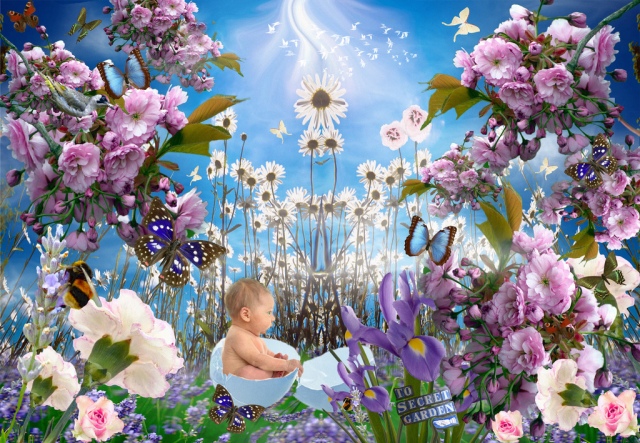
A Secret Scented Garden H. Newall, flowers: Graeme Dawes

Petty Cute Dance Puppets H. Newall
Little Beautiful Dance Puppets was a speculative piece, over again to explore Photoshop more than to make a collage, but it showed me what a little of what the software could exercise. Now, I need to starting time looking at the narratives in the collages. Mendzhiyskogo's work is fantastic, but Mach'southward work is stunning, and, I think, information technology is the implied narrative within the prototype which is the key…
Bibliography
Mach, D. (2011) Precious Light: http://www.davidmach.com: http://www.davidmach.com/photo-collage/; Transpositions: http://www.transpositions.co.uk/2011/09/featured-artist-david-mach/ Royal Academy: http://www.royalacademy.org.uk/academicians/sculptors/david-mach-ra,114,AR.html (accessed Dec 2013; Jan 2014)
(Re)Creating History: Annu Palakunnathu Matthew and Moira Shearer

An Indian from India Annu Palakunnathu Matthew
Via Jill Enfield, I came beyond the piece of work of Annu Palakunnathu Matthew, who makes beautifulwork with reconstructions of old photographs, sometimes in oratone. Enfield was giving a lecture for B and H Photography about her ain work in using old chemical darkroom techniques to make pictures. She offered examples of the work of others and Annu Palakunnathu Matthew was among the many names. Her work stood out for me, however, for several reasons. Matthew plays with layers and animations of people slowly superimposed over their younger selves. She also takes old photographs and superimposes herself into them and puts them side by side.The dazzler is in the content of the image, but alsoin the oratone itself (oratone beingness a collodion image, on glass, backed with gilded); it'south in the gentleness of the erstwhile monochrome images; and in the expression of the passage of fourth dimension which the digital reworkings – equally stills and animation – offering the viewer. Hither, the gentlecollision of ages in the slow animations annihilates the times between each image. Time passes far besides chop-chop. All too shortly nosotros are changed. And gone. We are all history… Time in photographs, still, is static: information technology shows us what we can never actually have, equally Barthes notes in Camera Lucida: 'What the Photograph reproduces to infinity has occurred simply one time: the Photograph mechanically repeats what could never be repeated existentially' (2000: 4). Matthew'southward reiterations are phantoms of moments that are unrepeatable, simply similar performances, they be as if iterated for the first time, existing forever in that uncanny operation limbo of being simultaneously real and unreal.
Matthew's work explores time simply also identity and 'otherness': she says in her creative person'southward statement:
As an immigrant, I am ofttimes questioned about where I am "really from." When I say that I am Indian, I frequently have to clarify that I am an Indian from India. Not an American-Indian, but rather an Indian-American, South-Asian Indian or fifty-fifty an Indian-Indian.
(http://www.annumatthew.com/artist%20statement/Indian_statement.html)
Fourth dimension, traced dorsum in the images, takes united states to when identity was firmly placed equally geographical, and if it was dissimilar it was 'other' and 'difficult': in her images, she plays the roles her interlocutors expect of her; she becomes 'really from' elsewhere. She thus plays with expectation, but with sense of humour and sadness. Her work mixes cross-dressing; cross-time; cross-generations; and cross-processes. Her use of old methods combined with digital forms undercuts it all as if to say: everything is, in whatever case, a mish-mash of former and new; old and young; male and female; here and there; heart and other. Everything is postmodern. Everything is iterated and reiterated, and not necessarily in that order.

And Indian from India Annu Palakunnathu Matthew
Matthew'south work is inspirational because in information technology I find combined several themes to which I myself continue returning. I am a digital photographer, merely I collect old photographs and make new images and animations with them.

Still from an animation Beach Dream H. Newall
I have a box of old portraits of people whose names and identities are nigh likely forever lost, and this sense of lost identity I notice fertile ground. I've spent hours digitally restoring some of these images, during which time at that place's been plenty of thinking nigh these forgotten people as I restore eyes, mouths, dresses, fingers… I pondered on what their names might take been. In most cases, there is no way of always knowing.
I've used some of these photographs to make images and animations for theatre projection, and I've had faint stirrings of ethical problems with this: I have therefore (I remember), never made an animation that disrespects the images or the people in them. I photographed Victorian grave stones once in Whitby for another project and had similar ethical stirrings. Since the stones in one field seemed to be separated from the state (and bodies) where they'd originally stood, hither were memories of people who were present in stone proper noun only, and the stones themselves were eroding in the rain, names melting away, one stone molecule at a time. The old photographs of people became for me, at that betoken, like these old grave stones: I imagined a field of argent people standing like stones… There's a movie I've all the same to make, exploring presence and absence and faces without names… This is an image personifying (literally, in the anonymous silent silver people) Sontag'south and Barthes's notion of death in the image: "All photographs are memento mori,' Sontag writes in On Photography, 'To have a photo is to participate in a person'due south (or a thing's) mortality, vulnerability, mutability' (1979: 15). And Barthes: 'Photography is a kind of primitive theatre, a kind of Tableau Vivant, a figuration of the motionless and fabricated-up face beneath which we see the expressionless' (2000: 32).
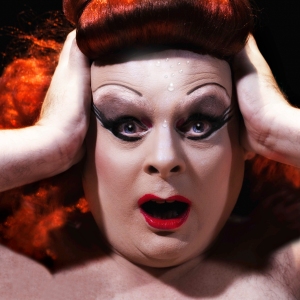
Mark Edward as Moira (2013) H. Newall

Moira Shearer as Vicky in The Red Shoes (1948) dir. Michael Powell
The second theme that interests me is reconstruction. In the fall of 2013 I staged an exhibition in collaboration with dancer and friend Marking Edward, in which iconic dance images are recreated, not however, by lithe young female ballerinas, but an overweight 40 year old drag queen (he won't heed me saying that!). The exhibition, Dying Swans and Dragged Upward Dames offered themes of fakery, pastiche, ageing and Photoshop. The images were fond and fun rather than pisstakes… We laughed making them. I hope they made people grin as they looked at the made-upwards faces of the Tableau Vivant we'd fabricated for them.
I quote some of the text I wrote to accompany the images: 'These are tragi-one-act images: The tragedy lies in knowing that the dancers nosotros watch will eventually become also past it to trip the light fantastic toe, the comedy from the bombastic contrast between able-bodied trip the light fantastic bodies and an aged, overweight one attempting and achieving (thank you Photoshop!) the aforementioned balletic feats. This exhibition fondly foregrounds cultural obsessions with youth and Photoshop, and the erasure of age in both alive performance – ballet, drag or otherwise – and the digital nighttime room, where ability and beauty can be airbrushed and 'improved'. These are images of old elevate ballet queens, flamboyant in the performance of being clapped out and over the colina, but still dancing.' (Exhibition Notes, Dying Swans and Dragged Up Dames, The Arts Center, Edge Hill University, Ormskirk, Oct 2013)
L.P. Hartley's The Go Between has an excellent first line, perhaps the best first line in a novel ever:
The past is a foreign state: they do things differently in that location.
I'm interested in historical processes and historical content and the differences (and mayhap the Derridean différances), betwixt so and now: Annu Palakunnathu Mathew demonstrates that this is not wholly a retrospective process, merely that there are new artifacts to be fabricated with historical things. They exercise practise things differently, alternatively, in the past, and as Harold Davis notes, they oft did things in the past long earlier we thought of (re)doing them: the commencement HDR print, he claims, was The Great Wave, made in 1857 past Gustav Le Grey… (2012: 16). So the old adage of there beingness nix new under the sunday probably holds true. We do things once more; we do things differently, différantly; sometimes consciously, sometimes unconsciously; nosotros remake the old to brand something new…
Bibliography
Barthes, R., (2000) Camera Lucida: Reflections on Photography, London: Vintage
Davis, H., (2012) Creating HDR Photos, New York: Amphoto Books
Enfield, J., (2013) Jill Enfield's Guide to Photographic Alternative Processes: Popular Historical and Contemporary Techniques, Abingdon: Focal Printing
Enfield, J., 'Guide to Alternative Photographic Processes, B and H online lecture, http://www.youtube.com/watch?five=ckkHW6f3xoI (accessed Dec 2013; Jan 2014)
Palannuathu Matthew, A., www.annumatthew.com (accessed: Dec 2013; Jan 2014)
Sontag, S., (1979) On Photography, London: Penguin Books
Shadows of the Past
A very important attribute of a photogram is this contact, how exercise I put it…a photogram is non a reproduced print, information technology is a contact picture. Y'all sense that the object was originally in contact with the movie.
(Floris Neusüss, 5&A, 2010; online)
Many practitioners are working with by forms. Artist, Bound Hurlbut, for instance, has worked in conjunction with Mike Robinson, to make daguerretypes of artifacts in a museum. Their piece of work is featured on Lady Lazarus's weblog. Whilst the loveliness of these kinds of projects is undoubted, they never excite me every bit much the ones where I feel, 'I could experiment with that.' In this sense, it is the shadowgrams that attract me, mainly considering I've done them before, and then long agone…
Two books in particular accept, therefore, opened up new artists to me considering they bargain with shadowgrams: Jill Enfield's Guide to Photographic Alternative Processes: Popular Historical and Gimmicky Techniques and Martin Barnes's Shadow Catchers: Camera-less Photography .
Enfield tin can besides exist constitute giving a presentation online. Her talk is fascinating: she discusses the variety of alternative methods she uses, but by and large she surveys the variety of artists making work with these other older chemical forms. 'Why limit yourself to just digital or film?' she asks, 'There are iii centuries of photography to piece of work with.'
Enfield discussed in her talk (admitting briefly) the work of Martha Madigan who makes beautiful large scale shadowgrams. The images are sensuous: you sense the presence of a real rather than a painterly body in the images, through what Neusüss terms 'contact'. But some of the images are mottled with leaves and the textures of grasses and flowers; others with intersections between positive and negative images. They are beautiful glowing things.

Graciela XII, Martha Madigan
The piece of work of Floris Neusüss is like in that he too works with shadowgrams and light sensitive paper, and oft uses the homo class.

Untitled Photograph Floris Neusüss
The silhouette is not a tightly focused well-baked prototype, but is rendered softer and more man past the blurring at the edges. Nosotros are given the suggestion of presence: this image is a map of the time when the light sifted effectually the flesh and reacted with the chemicals in the newspaper. The fourth dimension taken to make this image is undoubtedly more than for a usual exposure but it suggests that time is fleeting; that it slips away. The physicality of this process is appealing and numenous. The softness offers a fragility; the silhouette gives a sense of seeing something intimate or private, every bit though through a sheer pall: we are there, only not quite there with the bailiwick of the prototype. Barnes writes of his piece of work: 'it explores the forms of the trunk and external objects in a poetic dialogue between presence and absenteeism' (2010: 26). These are works which seem fifty-fifty more personal and intimate and, dare I say information technology, spiritual, than more than usual forms of photography.
There are other gimmicky artists and photographers working in this camera costless method – Susan Derges, Garry Fabian Miller, Adam Fuss to proper name the ones features in Barnes'due south volume – but it is these two, Madigan and Neusüss that inspire to me play with like forms. Their work is ethereal and breathtakingly cute.
Bibliography
Barnes, M., (2010) Shadow Catchers: Camera-less Photography, London: Merrell in association with the V&A
Enfield, J., (2013)Jill Enfield's Guide to Photographic Alternative Processes: Popular Historical and Contemporary Techniques, New York: Focal Press
Daguerre, then and now

Portrait of Louis Daguerre, 1844. Daguerreotype. Photographer: Jean-Baptiste Sabatier-Blot (1801-1881). Source: Wikimedia Commons
Louis-Jacques-Mandé Daguerre (1787-1851) was working in French republic in parallel with Trick Talbot. His procedure was farther developed in collaboration from 1829 with Joseph Niéphore Niépce who died in 1833, leaving Daguerre to progress the work alone. Daguerre announced his discoveries in 1839, and whilst recognising Niépce's significant part in them, named the procedure the daguerreotype, leaving Niépce'south term, heliography, behind. This is a history littered with lost terminology. According to the Online Etymological Dictionary, the term photography was well-nigh likely coined past Sir John Herschel in 1839.

An 1854 two-panel cartoon on the vagaries of early photography, published in the Dial's Almanack for 1855. Caption to top panel: "Interesting group posed for a Daguerrotype by a friend of the family". Explanation to bottom console: "Interesting and valuable result" (the family photograph has actually turned out horribly). Source: wikimedia commons
Whatever the term, the announcements on both sides of the Aqueduct caught the imagination of the world, merely it was Daguerre's process from the start that proved more popular. In 1840, Edgar Allen Poe announced the importance of Daguerre's camera: 'The instrument itself,' he wrote, 'must undoubtedly exist regarded equally the about important, and mayhap the most extraordinary triumph of modern science' (in Trachtenberg, 1980: 37).
The daguerreotype was, however, not without its detractors, every bit a satitical cartoon from Punch in 1855 demonstrates. At first, exposure for a daguerreptype took hours, and although this was reduced within a year to only minutes, information technology was still problematic and 'notwithstanding placed limitations on the option of subject area' (Clarke, 1997: 15). A commentator writes in The Spectator in 1841: 'To render the Daguerreotype applicable to the purpose of portraiture, information technology was necessary to accelerate the action of light on the plate; for rapid as was the formation of the image, fifty-fifty v minutes was too long for whatever sitter to remain perfectly still. This has been accomplishe d past various modifications of the chemical preparation of the plate…' (The Spectator, London, iv September 1841: online resource, The Daguerreia due north So ciety). There are plenty of articles with advice on how to how daguerreotype children, and a flurry of inventions for holding heads and arms still. In a periodical entry dated 24 October 1841, Ralph Waldo Emerson writes:

Daguerreotype portrait of Scottish novelist and poet Robert Louis Stevenson equally a child. Unknown photographer. Courtesy of the Beinecke Rare Book & Manuscript Library, Yale University. Source: Wikimedia Commons
'Were you ever Daguerrotyped, O immortal man? … and in your zeal not to blur the paradigm, did you continue every finger in its identify with such free energy that your easily became clenched equally for fight or despair, & in your resolution to keep your face still, did you feel every muscle becoming every moment more rigid …' (Emerson, 1841,online resource: The Daguerreian Society). It was also difficult to view since its argent metal surface reflected low-cal, only despite its drawbacks, Daguerre's method spread fast and far afield, enjoying considerable success in America, every bit is evidenced by the hyperbole in the article 'Heliography in New York', La Lumiere, 1852, onlineresource: The Daguerreian Society); and in the comments of Lady Elizabeth Eastlake in 1857 in her essay Photography published in the Quarterly Review: 'As early as 1842 i individual, of the name Bristles, assumed the calling of daguerreotype artist. In 1843 he ready establishments in four different quarters of London' (Eastlake in Trachtenberg, 1981: 40).
But daguerreotypes were, in the finish, a fleeting innovation in the Chiliad Narrative of the History of Photography, as Damisch and Berger state: 'the starting time inventors worked to prepare images and simultaneously to develop techniques for their mass distribution, which is why the process perfected by Daguerre was doomed from the very outset, since it could provide nothing merely a unique image' (Trachtenberg, 1981: 290). Whilst the world now reveres the digital image, and film piece of work recedes dangerously shut to extinction in the popular conception of what photography is, daguerreotypography is now only used by enthusiasts such every bit the members of theThe Daguerreian Society, and artists such every bit Chuck Close working with Jerry Spagnoli, and Spring Hurlbut in collaboration with daguerreotypist Mike Robinson.
The early inventors of photography sought mass production, and from the outset, perhaps influenced by this desire for mass product, there was debate every bit to its cultural status: was it a scientific discipline? Was information technology a craft? Was it, Heavens forfend, an art? This was a fence which in 1839 was already waiting for Walter Benjamin's 1936 essay, 'The Piece of work of Art in the Age of Mechanical Reproduction' in which he cites Paul Valéry: 'Only as h2o, gas and electricity are brought into our houses from far off to satisfy our needs in response to minimal efforts, and then shall nosotros be supplied with visual or auditory images…' The flood of these images did not began in 1839 – lithography was already illustrating our lives in newspapers and journals – but Daguerre and Fox Talbot et al certainly opened the floodgates to bring u.s. to the state where today, according to Qmee at that place are 20 million photograph views on Flickr, 104 1000 photos shared on Snapchat, and 3,600 Instagrams every 60 seconds…
Thou. Daguerre, qu'avez vous faits?
Bibliography
Benjamin, Due west., 'The Piece of work of Fine art in the Age of Mechanical Reproduction' in Walter, B., H. Zohn (trans.) (1968) Illuminations: Essays and Reflections, New York: Schocken Books
Clarke, G., (1997) The Photograph: A Visual and Cultural History, Oxford Paperbacks.
Trachtenberg, A. (ed.) (1980) Archetype Essays on Photography, New Haven: Leete's Island Books
Watson. R., & H. Rappaport. (2013) Capturing the Light, London: Macmillan
Source: https://blacktulipimages.com/
0 Response to "Bibliogroupthe Corsair a Gazette of Literature Art Dramatic Criticism Fashion and Novelty"
Post a Comment