Can Neptune Be Seen at Night Without a Telescope
How to meet Uranus in the night sky (without a telescope) this week

Just how many planets are visible without a telescope? Not including our own planet, most people will respond "5" (Mercury, Venus, Mars, Jupiter and Saturn).
Those are the five brightest planets, but in reality, there is a sixth planet that can exist glimpsed without the aid of either a telescope or binoculars.
That 6th planet is the planet Uranus. This week volition be a fine time to endeavour and seek it out, especially since it is now favorably placed for viewing in our late-evening heaven and the bright moon is out of the way.
Related: Photos of Uranus, the tilted giant planet
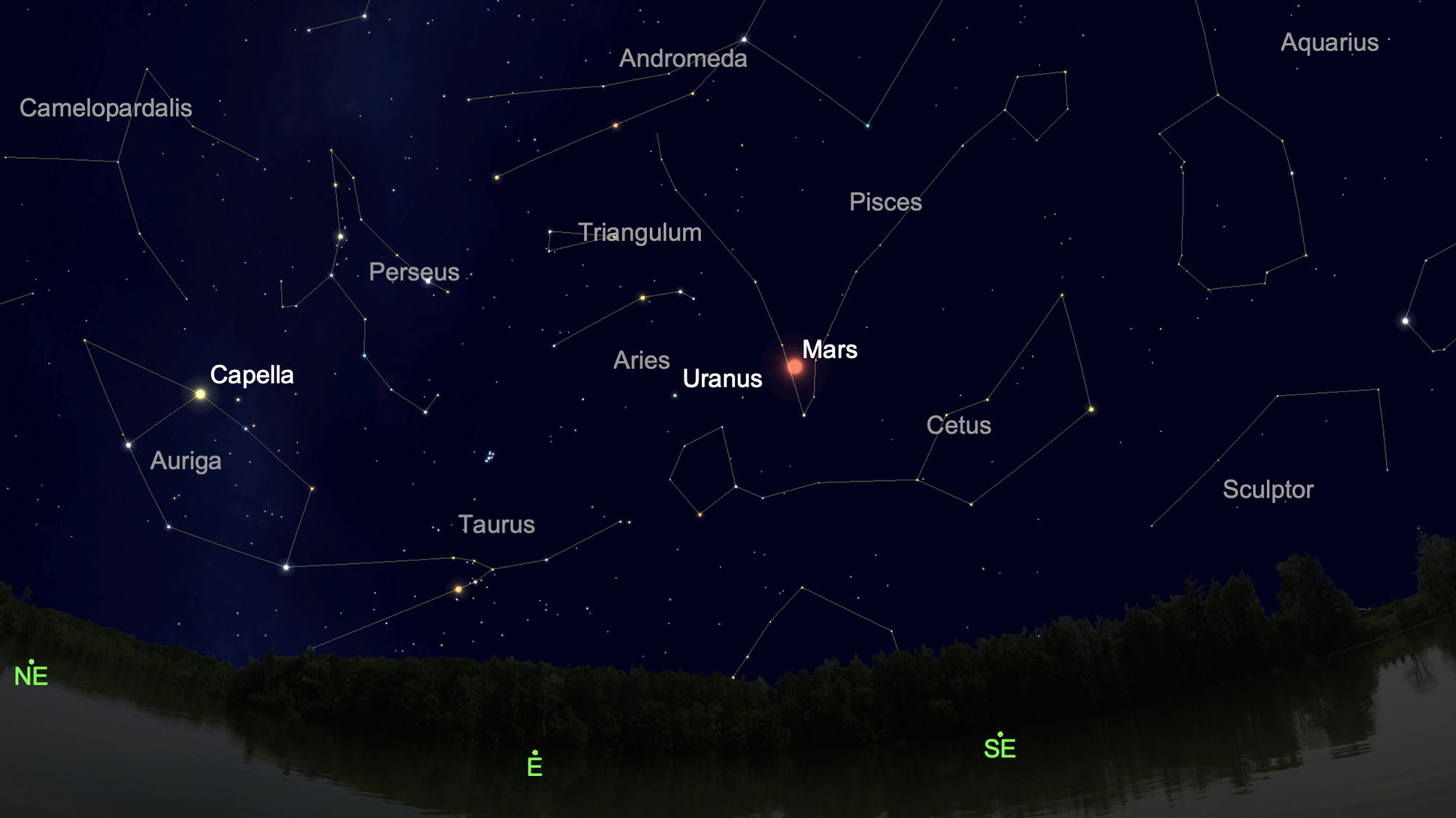
Of course, you'll have to know exactly where to look for it. Astronomers measure out the brightness of objects in the dark heaven as magnitude. Smaller numbers indicate brighter objects, with negative numbers cogent exceptionally vivid objects. Merely Uranus is currently shining at magnitude +5.seven, relatively dim on the scale; barely visible past a keen naked eye on very night, clear nights.
It is currently located within the constellation of Aries, the Ram, nigh a dozen degrees to the east (left) of the bright planet Mars. Information technology'due south already 1-third upwardly from the eastern horizon by 11:30 p.grand. local daylight time and will reach its highest indicate — more than ii thirds upwards from the southern horizon — simply before four a.m.
Information technology is best to report the accompanying nautical chart first, then scan that region with binoculars. Using a magnification of 150-power with a telescope of at least iii-inch aperture, you should be able to resolve information technology into a tiny, blue-greenish featureless disk.
An icy, cold earth
This week Uranus is nigh 1.771 billion miles (2.851 billion kilometers) from Earth (only Neptune is further away). It takes 84.4 years to orbit the dominicus. The planet has a diameter of most 31,518 miles (l,724 km), making it the third-largest planet, and according to flyby magnetic information from Voyager two in 1986, has a rotation period of 17.23 hours.
At last count, Uranus has 27 moons, all in orbits lying in the planet'southward equator in which there is likewise a complex of nine narrow, virtually opaque rings, which were discovered in 1978.
Uranus probable has an icy, rocky cadre, surrounded by a liquid drape of water, methane and ammonia, encased in an atmosphere of hydrogen and helium. In fact, Uranus has the coldest atmosphere of any planet in the solar system with a minimum temperature
of -371 degrees Fahrenheit (minus 224 degrees Celsius).
A freakish tilt
A bizarre feature is how far over Uranus is tipped. The other planets are tilted somewhere between 3 degrees and 29 degrees, merely Uranus' north pole lies 98 degrees from being direct up and down to its orbit plane.
From our bespeak of view, this ways that sometimes we see Uranus with its north pole pointing at us. At other times we come across it with its equatorial belt oriented vertically instead of horizontally. From the point of view of a hypothetical astronaut visiting Uranus, daylight and darkness would exist zip short of extraordinary. Its seasons are extreme: when the sun rises (as an case) at the due north pole, information technology stays upwardly for 42 World years; and then information technology sets and the north pole is in darkness for 42 World years.
Accidental discovery
In the late winter of 1781, British astronomer Sir William Herschel had just finished building a new half dozen.iii-inch (16 centimeters) reflecting telescope and began to written report the stars through information technology. On the night of March 13, he had his telescope turned on the constellation of Gemini, the twins. There, to his great surprise, he came across an extra star that was not plotted on any of his star charts. An accomplished astronomer, Herschel was quick to realize that what he establish could not peradventure be a star, for it appeared in his telescope every bit a glowing disk every bit opposed to a twinkling speck of lite.
Continuing his observations of this unusual object dark later night, Herschel soon perceived motion; information technology was slowly shifting its position among the background stars of Gemini. Finally, he decided that he had discovered a new comet and he wrote up a detailed report of his observations, which were published on Apr 26.
The report of a new comet excited astronomers all over Europe, and they all eagerly trained their telescopes on Herschel'due south discovery. King George Iii, who loved the sciences, had the astronomer brought to him and presented him with a life alimony and a residence at Slough, in the neighborhood of Windsor Castle.
Multiple monikers
Soon, enough observations were made to calculate an orbit for Herschel'southward "comet." That's when an increasing number of astronomers began to doubt that what they were looking at was really a comet. For one affair, information technology seemed to be post-obit a nearly circular orbit out beyond Saturn.
Somewhen it was determined that Herschel'due south "comet" was in fact a new planet. For a while, information technology actually bore Herschel'south name, though Herschel himself proposed the name Georgium Sidus — "The Star of George," afterward his generous benefactor. Still, the custom for a mythological name ultimately prevailed and the new planet was finally christened Uranus.
Related: Who discovered Uranus (and how do yous pronounce it)?
Prior to its discovery, the outermost planet was considered to be Saturn, named for the ancient god of time and destiny. Only Uranus was the grandpa of Jupiter and begetter of Saturn and considered the most aboriginal deity of all.
It probably was for all for the all-time. Afterward all, if Herschel's request was granted, just recall of how nosotros might have listed the planets in order from the sun: Mercury, Venus, Earth, Mars, Jupiter, Saturn and ... George?
And then came Neptune
Interestingly, it was Uranus that led astronomers, 65 years later, to Neptune, fourth and last of the behemothic planets. Information technology's a fascinating story and came virtually this way:
By plotting the path of a planet, astronomers can describe upward a table (called an "ephemeris") that can bear witness them exactly where the planet will be at whatsoever given time. And so, after the discovery of Uranus, they set about determining an ephemeris for it.
Only this method didn't seem to work; sometimes Uranus turned up ahead of its predicted position; sometimes it lagged behind. It seemed to astronomers that some unknown body was somehow perturbing Uranus's orbit.
In 1846, two astronomers, Urbain J.J. Leverrier (1811-1877) of France and John Burrow Adams (1819-1892) of England independently were working on this very problem. Neither knew what the other was doing, but ultimately, both men had figured out the probable path of the supposed object that was agonizing the orbit of Uranus. Both believed that the unseen torso was so in the constellation of Aquarius.
Adams was a student at Cambridge University, and he sent his results to Sir George Blusterous (1801-1892), the Astronomer Royal, with specific instructions on where to look for information technology. For some unknown reason Airy delayed a year before starting the search. In the meantime, Leverrier wrote to the Berlin Observatory requesting that they search in the place he directed. Johann Galle and Heinrich d'Arrest at Berlin did exactly every bit instructed and institute the new planet in less than an hr.
The naming of this new eighth planet was more complicated than for Uranus. Initially, Janus and Oceanus were suggested. Leverrier wanted information technology to exist named after him. Merely while the population of French republic seemed in favor of this, the other European countries resisted this moniker. Eventually, information technology was named for Neptune after the god of the body of water.
Ice giant
Neptune is slightly smaller than Uranus, measuring thirty,599 miles (49,244 km) in bore. Like Uranus, Neptune is a frigid world, with temperatures at its cloud tops of -361 degrees F (-218 C). Because they are like both in size and temperatures, Uranus and Neptune are referred to as "water ice giants."
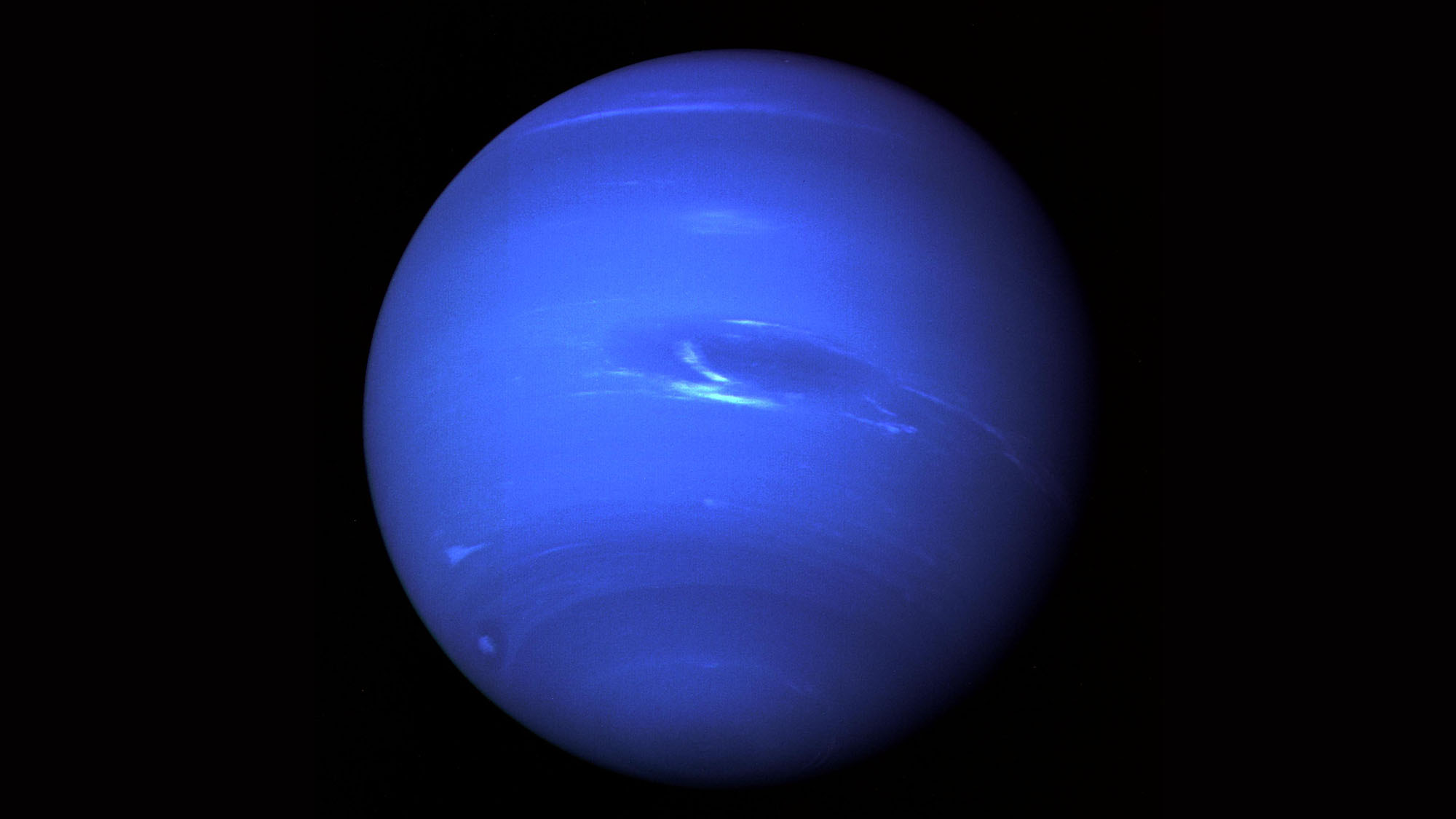
Voyager 2 passed Neptune in 1989 and showed it to possess a deep-blueish temper, primarily composed of hydrogen, helium and methyl hydride with rapidly moving wisps of white clouds too as a Great Dark Spot, rather similar in nature to Jupiter's famous Great Cerise Spot.
Related: Photos of Neptune, the mysterious blue planet
Because of its gaseous composition, its speed of rotation varies from 18 hours at the equator to just 12 hours at the poles. This differential rotation is the most pronounced of any other planet and results in exceedingly stiff winds reaching speeds upward to 1,300 mph (2,200 kph). Nigh of the winds on Neptune move in a direction opposite to the planet's rotation.
Voyager two also revealed the existence of at least three rings effectually Neptune, composed of very fine particles. Neptune has 14 moons, 1 of which, Triton has a tenuous atmosphere of nitrogen and at virtually 1,700 miles (2,700 km) in diameter, is larger than Pluto.
Finding Neptune
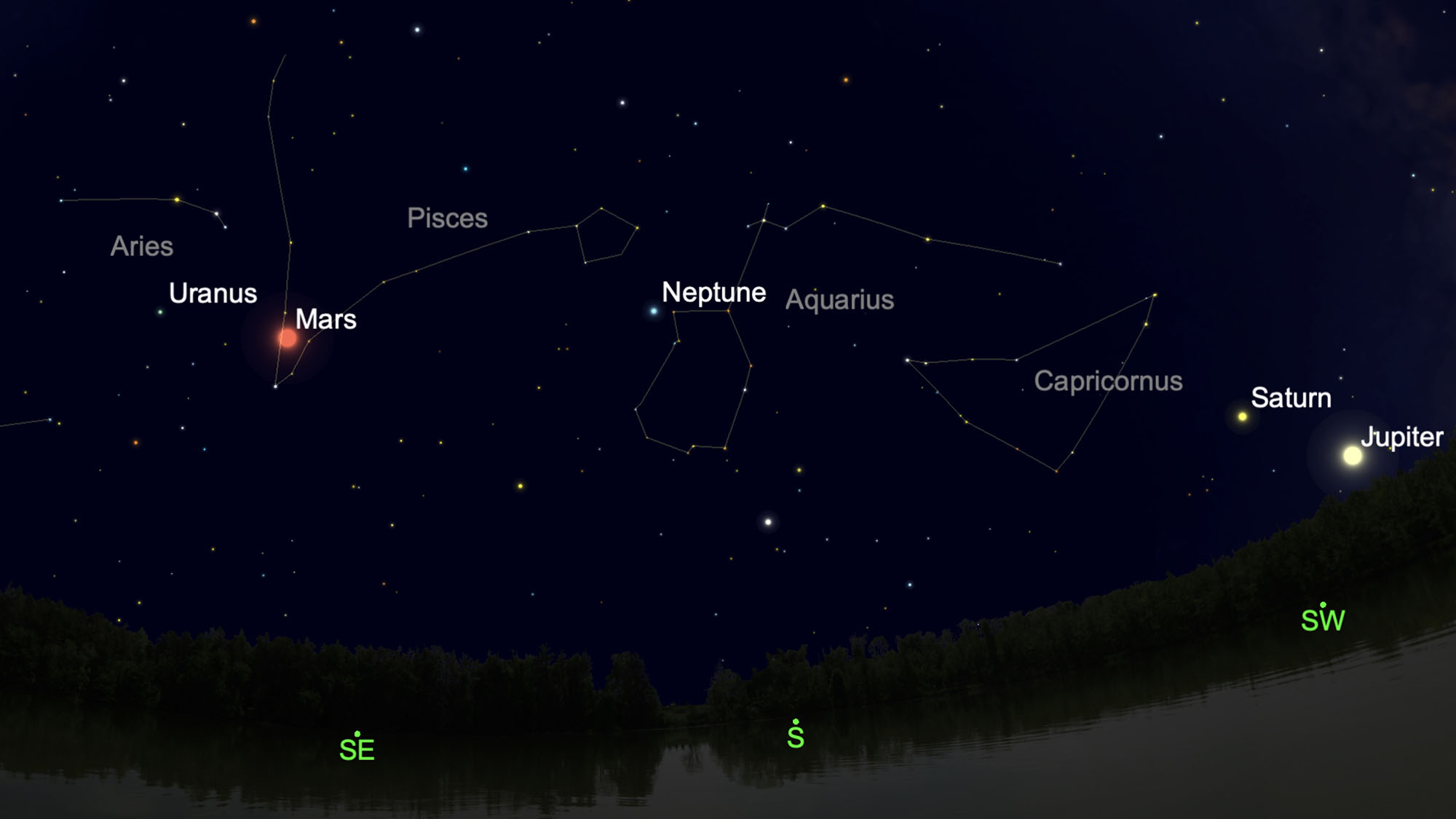
Different Uranus, Neptune is much too faint to be viewed with the unaided eye, lying at a mean distance from the lord's day of 2.eight billion miles (4.five billion km); the near distant planet. It's about seven times dimmer than Uranus, merely if you have access to a dark, clear sky and carefully examine the map above, you should have no trouble in finding it with a practiced pair of binoculars.
September is Neptune'due south month. Information technology will be at opposition to the sun on Sept. xi, and so it will be in the sky all night long, reaching its highest point in the southern sky at around ane a.1000. local time. Neptune can currently be plant amongst the stars of Aquarius, the water bearer.
With a telescope, trying to resolve Neptune into a deejay will be more difficult than it is with Uranus. Yous're going to demand at least a 4-inch (x cm) telescope with a magnification of no less than 200-power, just to turn Neptune into a tiny blue dot of light.
Cases of mistaken identity
Lastly, in deference to Herschel and Leverrier, they are not the showtime discoverers of Uranus and Neptune. Uranus may have been offset charted (mistakenly) every bit far dorsum as 128 B.C. by the Greek astronomer and mathematician Hipparchus of Nicaea, including it as a faint star in his catalogue. In 1690, the English astronomer John Flamsteed catalogued Uranus every bit the star 34 Tauri, and the French astronomer Pierre Charles Le Monnier saw it no less than twelve times between 1750 and 1769, never realizing that what he was looking at was not a star but a new planet.
And Neptune was very most discovered by none other than the renowned Italian astronomer Galileo Galilei with his crude telescope. Galileo unknowingly recorded Neptune equally an eighth-magnitude star while observing Jupiter and its organization of four large satellites on Dec. 28, 1612 and again on Jan. 27, 1613. If he had only continued to keep lookout in the following nights, he would have almost certainly would take realized that 1 of the background stars was moving.
He would accept then discovered the eighth planet near 170 years earlier the discovery of the seventh!
Joe Rao serves as an instructor and invitee lecturer at New York'south Hayden Planetarium. He writes about astronomy for Natural History mag, the Farmers' Annual and other publications. Follow us on Twitter @Spacedotcom and on Facebook.
Bring together our Space Forums to go on talking infinite on the latest missions, nighttime heaven and more! And if y'all take a news tip, correction or comment, permit united states of america know at: community@space.com.

Joe Rao is Space.com's skywatching columnist, likewise as a veteran meteorologist and eclipse chaser who also serves as an instructor and invitee lecturer at New York's Hayden Planetarium. He writes nigh astronomy for Natural History mag, the Farmers' Almanac and other publications. Joe is an 8-time Emmy-nominated meteorologist who served the Putnam Valley region of New York for over 21 years. Yous can observe him on Twitter and YouTube tracking lunar and solar eclipses, meteor showers and more than. To find out Joe's latest project, visit him on Twitter.
Source: https://www.space.com/uranus-neptune-skywatching-september-2020.html
0 Response to "Can Neptune Be Seen at Night Without a Telescope"
Post a Comment